

Twenty Years in the Dark
How a sensor on my arm and an AI on my phone finally made diabetes make sense

Quick disclaimer: I am not a doctor. I don’t play one on TV. Nothing in this essay is medical advice, and it is absolutely not a substitute for the guidance of an actual healthcare professional who went to actual medical school. Please talk to your doctor. Especially if your doctor is better than my first one.
I was at work, washing down a Twix bar with my second Dr. Pepper of the day. Probably my second of five. My phone rang. It was my doctor with the results of my recent blood work.
You have diabetes.
I don’t remember much of what he said after that. I remember the advice, though, because it was spectacularly unhelpful. Stop eating sweets. Lay off the cake, the ice cream, the sodas. That was about it. No real plan. No framework. Just... stop doing the things you’re doing.
I fired that doctor not long after.
But replacing the doctor didn’t replace the confusion. What started that day was nearly two decades of managing a disease mostly in the dark.
Here’s how diabetes management worked for me, for a long time. I had a glucose meter. I could prick my finger, get a number, and know what my blood sugar was at that exact moment. One moment. One snapshot. And to do it properly, one snapshot wasn’t enough. You’re supposed to test multiple times a day, at precise intervals. Before meals. Two hours after meals. Before bed. It becomes the organizing principle of your entire day. I wanted to control this thing, but I could never get on board with a lifestyle that revolved around a needle and a timer. So I’d try for a day or two, then not test at all for weeks. Then every three or four months, I’d get my A1C results back and hold my breath.
The A1C was always a surprise. Sometimes better than expected. Usually not. And the frustrating part was that I could never connect the dots between what I did day to day and what that number said about the last ninety days. It was like getting a grade on a test where nobody showed you the questions.
I tried different medications over the years. Some worked better than others. Some made me gain weight. Some made me lose it. One made me nauseous enough that I dreaded taking it. They all moved the needle in varying degrees, but none of them gave me the thing I actually needed. Which was understanding.
It was easier, in a lot of ways, to just kind of ignore it. Not because I thought diabetes would go away. But because trying to manage something you can’t see or measure in any meaningful way is exhausting. Eventually, you stop trying so hard. You just hope the next A1C isn’t too bad.
I eventually found a great doctor. One of those “Best Doctor” award winners. She was thorough, she listened, and her advice was simple: take a fasting glucose reading every morning when you wake up.
Sounds manageable, right?
The problem was that every single morning, the number was higher than it should have been. She told me it should be in the low 100s or below. Mine was consistently in the upper 100s. Or worse. Every morning I’d stick my finger, see a bad number, and start the day already feeling like I was failing.
Looking back, I should have told her it wasn’t working. Should have said, “Hey, this is discouraging and I need a different approach.” But instead I did what I’d always done. I quietly stopped trying and let the problem fade into the background, until the next A1C results came. That wasn’t her fault. She is a great doctor who was giving me sound advice. I just wasn’t ready to have an honest conversation about the fact that I was losing the fight.
And through all of it, I was playing a losing game with willpower. I’d deprive myself of things I enjoyed. Ice cream, carbs, anything that felt like a treat. I’d gut it out for a while, feeling virtuous but miserable, until eventually the willpower would crack. And when it cracked, it didn’t crack a little. I’d overindulge. Then the guilt would set in, and I’d start the cycle all over again. Deprive, resist, break, overdo it, feel terrible, repeat. The whole time, I was cutting out foods that turned out to be perfectly fine for my blood sugar and eating things I assumed were safe that were quietly making everything worse. I just had no way of knowing which was which.
Fast forward to 2024. I’d been hearing ads for continuous glucose monitors on podcasts for months. The pitch was compelling. What predicts lower A1C isn’t random finger sticks. It’s how much time you spend “in range” throughout the day. And a CGM tracks that continuously. A small sensor on your arm. Connected to your phone (and now watch!). Numbers updating in real time, all day, all night.
I talked to my doctor, got a prescription, navigated the insurance maze (they didn’t cover it at first, so I used a discount program until they did), and put the sensor on my arm.
For the first time in twenty years, I felt like I was playing the game with the lights on.
The discoveries came fast.
I’d always been a cereal person in the morning. Loved it. But within days of wearing the CGM, I could see that cereal first thing in the morning sent my blood sugar climbing. Switching to protein in the morning made a visible, immediate difference.
Then came the ice cream experiment.
I’d read an article in The Atlantic about some research out of Harvard. People who ate moderate amounts of ice cream actually showed a slightly lower risk of developing type 2 diabetes. Now, that doesn’t mean ice cream is health food. It was observational data, not proof of anything, and the researchers had plenty of caveats. But the finding stuck with me because it said something I’d never considered: nutrition science doesn’t always work the way you’d assume. And because fat and protein slow down how your body absorbs carbohydrates, ice cream can produce a smaller glucose spike than something like a plain bagel. I didn’t need to take anyone’s word for it, though. I had a sensor on my arm.
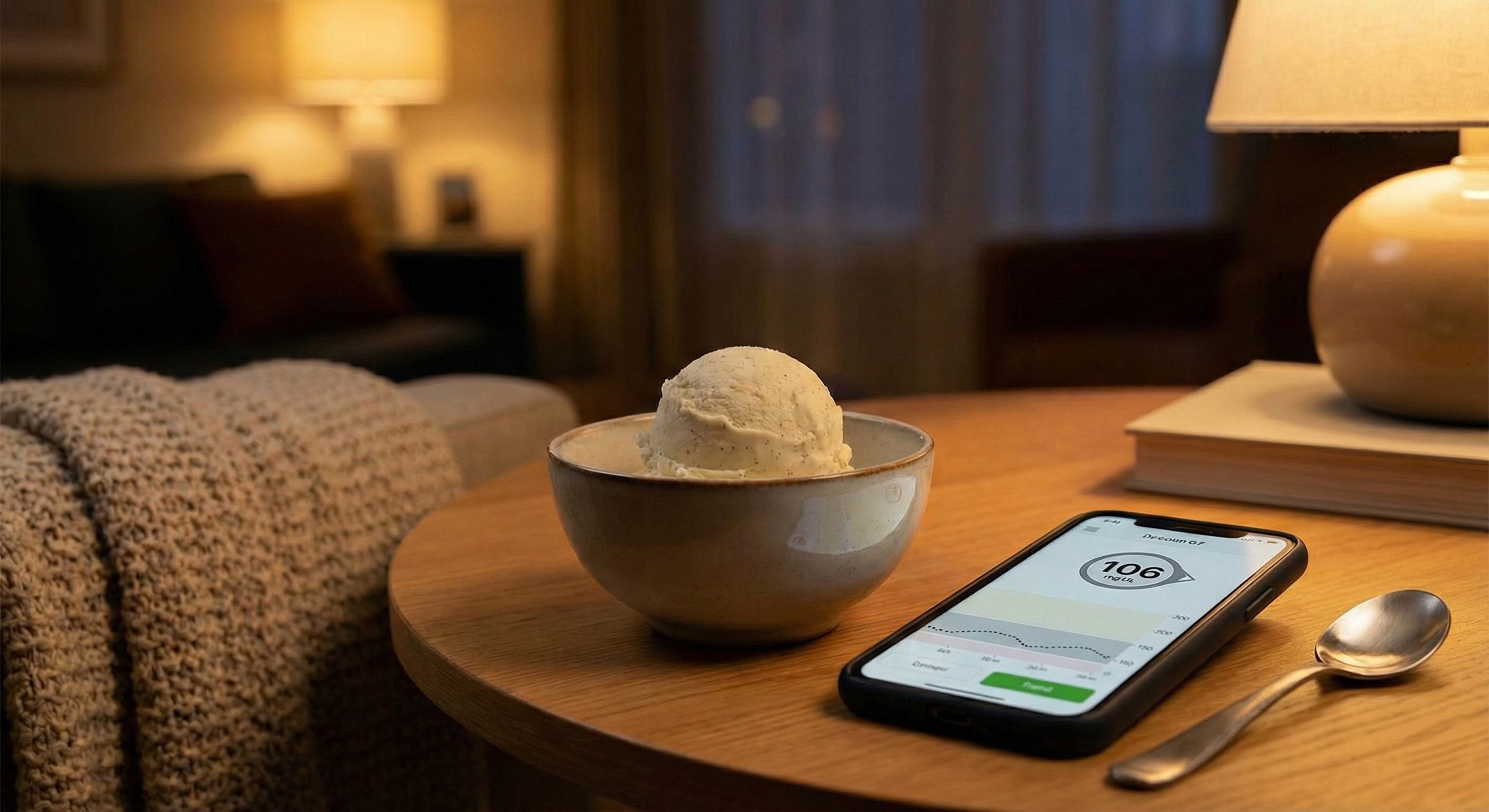
I bought a high-quality vanilla bean ice cream. Made myself a small bowl. Ate it slowly. And watched.
No spike. Hardly a blip.
The next night, same thing. Same result.
Meanwhile, a whole wheat bagel in the morning would absolutely wreck me. Certain beers spiked my numbers. Others didn’t. Sourdough toast at 7 a.m. sent my glucose climbing. The exact same slice of sourdough at 3 p.m.? Barely moved the needle.
I learned that pasta at dinner (in reasonable portions) was surprisingly fine. That protein in the morning was non-negotiable. That four Thin Mints (I counted) caused no spike at all. And once I knew what was actually okay, something shifted in how I ate. I didn’t need cheat days anymore. I didn’t need to gorge on a treat because who knows when I’d let myself have it again. If four Thin Mints were fine tonight, four Thin Mints would be fine tomorrow. Moderation got easier when it stopped feeling like deprivation.
This went on for about a year and a half. Constant, quiet experimentation. Every meal was a data point. Every snack was a test. And slowly, the picture of how my body actually worked started to come into focus.
One of the biggest discoveries was something called the dawn phenomenon. Around 4 a.m., my blood sugar starts climbing on its own. It doesn’t matter what I ate the night before. It just happens. My body releases glucose to prepare for waking up, and because I’m diabetic, I can’t process it efficiently.
That single piece of information reframed twenty years of frustration.
All those mornings I stuck my finger and saw a high number? All those times I felt like I must have eaten something wrong the night before? It wasn’t something I did. It was something my body does. Every doctor who told me to test in the morning and aim for a low number was giving me a target I was almost biologically guaranteed to miss.
I can’t overstate how much that changed my relationship with the disease. I went from “I keep failing” to “Oh. So that’swhat’s been happening.”
Around this same time, I started a GLP-1 medication and got more serious about strength training. The weight started coming off. I dropped to the lowest I’d been since high school. And at some point last summer, something shifted. My numbers didn’t just improve. They stabilized. The roller coaster flattened out.
I wanted to understand why. So I did what I’ve been doing more and more lately. I took my data to ChatGPT.
I fed it my workout logs, my scale data, my CGM trends, my lab results. And I asked it to help me figure out what had changed.
The answer was visceral fat. When my body composition shifted enough that my visceral fat dropped past a tipping point, glucose control got dramatically easier. That was the switch. Not a single food change or a single medication. It was a tipping point in body composition that made everything else work better.
That insight motivated me more than any doctor’s advice ever had. Not because the doctors were wrong. But because I could see it. In the data. In the trends. In the way the numbers told a story I could finally read.
AI became something like a personal health analyst after that. I exported my MyFitnessPal logs and uploaded them. I shared lab results and asked questions about individual values. When one marker came back higher than normal, I asked ChatGPT to analyze it in context with my other results. It walked me through why it was likely an isolated abnormal reading and not something to panic about. A few weeks later, I saw a nutritionist who made the exact same dietary recommendations ChatGPT had already given me.
It recommended four supplements based on my bloodwork and goals. I ran them by my clinical pharmacist. She said it was exactly right.
I want to be clear. I’m not replacing my doctors. I’m walking into their offices better informed, with better questions, and with a clearer picture of what’s actually going on. When I had surgery a couple of years ago, the hospital put me on their standard “diabetic diet.” It included pudding and graham crackers. My blood sugar spiked constantly, and they gave me insulin to manage the spikes their own menu was causing. They weren’t doing anything wrong by the book. But the book doesn’t know my body. The real power is in the data. The CGM, the nutrition logs, the health metrics from my watch. That’s the foundation. AI just helps me connect the dots, spotting patterns across months of information that I’d never piece together on my own.
After nearly two decades of managing this disease blindfolded, I posted back-to-back A1Cs of 6.6 and 6.5. Not through white-knuckling it. Not through deprivation or willpower. Through understanding.
And now that I’m in the zone, something funny has happened. I don’t obsessively check the CGM anymore. For almost two years, I watched it constantly. Every meal, every snack, every morning. But staying in range comes naturally now. I check in occasionally to make sure I’m still on track, the way you’d glance at a GPS when you already know the route. Diabetes isn’t something I ignore anymore. But it also isn’t always present in my thoughts. The anxiety is gone.
A sensor that costs less than a dinner out can show you, in real time, how your body responds to what you eat. An AI can take months of that data and help you see patterns you’d never catch yourself.
You just have to be willing to look at the numbers. And then let the numbers show you what to do next.